
Start a Conversation
Menu

Give Your Campaign One Clear Action

Direct Response
Marketing

Give people a specific reason to call, send an inquiry or place an order. Revenue Surge connects the offer, campaign creative and landing page, then helps you check what reaches your team and which outcomes your records can verify.

Two people looking at product creative on a screen, with a tablet and product printouts nearby

Clarify the Offer 
Check the Response

Define Who the Offer Is For

Identify who needs the offer, where you can serve them, and what they need to know before acting.

Make the Next Step Clear

Give people a clear way to call, ask about the offer or place an order.

Measure What Matters

Check which inquiries reached your team, which fit and which led to sales. For products, verify orders and revenue in your store records.

Campaign Responses and Sales

What Happens After Someone Responds?

A full inbox can hide poor fit. A product promotion can win orders while leaving too little margin. A strong inquiry can stall when nobody owns the next conversation.

Choose the Action and How to Check It

Start with the offer and the action you want someone to take. Check whether the creative and landing page explain the same terms and whether calls, forms or orders reach the right place.

Discuss Your Campaign

What Is Happening in Your Campaign?

People respond, but the inquiries rarely fit.

The site records checkout starts, but the order system confirms few purchases.

The campaign reports responses your inquiry or order records cannot confirm.

Launching a new offer? The same questions help define the buyer, the response, and the evidence you will need before spending more.

Flozyte product page screenshot showing packaging, a radio promotion strip and an Order Now button

A Direct Response Product Example

How Flozyte Presented Its Offer and Order Button

Revenue Surge developed Flozyte’s name, logo, product labels, website and copy, and worked on ecommerce conversion. The screenshot shows the product packaging, a radio promotion strip and an Order Now button.

01

The Name and Product Identity

The Flozyte name and packaging appear together at the top of the page.

02

The Radio Promotion

The page shows a radio promotion banner below the main product offer and Order Now button.

03

The Order Now Button

The button shows the next action the page asks for. Checking whether an order goes through requires the working checkout and order records.

Selected project artwork showing naming, product labels, page design, and the order action.

Explore Our Ecommerce Portfolio

The Same Symptom Can Have Different Causes

What Should You Check Before Changing the Campaign?

A campaign symptom can point to the audience, the offer, the page or a gap in the records. These examples show which evidence to check first.

What You Notice

Inquiries Arrive but Rarely Fit

The team receives inquiries, but few match the services, locations or jobs it can handle.

Evidence to Check →

Compare the requests with the audience, ad promise, service area, and your definition of a suitable inquiry.

The Decision It Informs

Review audience and offer fit before removing qualification questions or buying more of the same traffic.

What You Notice

Checkout Starts With Few Confirmed Orders

Tracking records checkout starts. The order system shows whether those starts became confirmed orders when records can be matched.

Evidence to Check →

Check device behavior, total cost, delivery information, payment options, and the point where buyers leave.

The Decision It Informs

Verify and fix a checkout failure within scope. If the path works, use customer questions and available records to check the offer, total cost and terms.

What You Notice

Suitable Inquiries With Unclear Sales Outcomes

Requests that fit reach your team, but the records leave it unclear which prospects were contacted or became customers.

Evidence to Check →

Check contact attempts, qualification status, recorded sales, and whether those outcomes can be linked to their source.

The Decision It Informs

Assign who responds, who checks fit and who records confirmed sales. Leave outcomes unknown where the records do not confirm them.

Use the symptom to choose a first check. Look for evidence of the cause before committing to a change.

Before Scaling the Response

What Does Each Response Cost and What Does It Lead To?

A discount can raise order volume while reducing what remains per order. A low cost per inquiry can still mean a high cost per new customer. Agree which costs to include, which genuine inquiries or confirmed orders to count, and which period or group to compare.

For a Product Order

Start With Net Order Revenue

Start with order revenue after discounts, cancellations and refunds. Count each adjustment once and use a consistent rule for shipping charges paid by customers.

Account for the Cost to Deliver

From net order revenue, deduct variable costs such as the product, fulfillment, shipping, payment fees and return handling. Count each expense once.

Contribution Before Acquisition Costs

What remains must cover acquisition, fixed overhead, and the profit your business needs. Revenue alone is not the budget.

Compare what an order contributes with the cost of acquiring it before increasing spend.

For a Service Inquiry

Define a Suitable Inquiry

First verify which inquiries are genuine, unique and received. Then assess the service need, location and other criteria your team uses to judge fit.

Follow It Through the Sale

Count each genuine inquiry that arrived once. Record which ones qualify and which become confirmed new customers, using the same group and allowing time for sales to close.

Check Capacity and Customer Value

Divide the acquisition costs you agreed to include by confirmed new customers from the same group or period. Check what their work contributes and whether your team can take on more of it.

Use what you can verify about receipt, fit and confirmed sales to decide whether to change the campaign.

If the Campaign Succeeds, Can Your Business Support the Response?

Available inventory, fulfillment, scheduling, customer service, and the capacity to contact inquiries can affect what makes sense to promote. Agree on the constraint and the next practical improvement before expanding investment.

This model helps you plan with the costs and revenue you can verify. Include repeat purchases in a separate estimate only when your customer records support it.

The Offer Is More Than a Headline

Define the Offer, Terms and Next Step

The brief names who the ad addresses, what the offer includes and what customers should do next. Use the approved facts and terms to guide the creative and landing page.

The Campaign Brief

One Buyer.
A Relevant Promise.
A Defined Response.

Check that the creative and landing page describe the same offer, terms and next action. Then confirm that the contact or order step works as described.

Who Is It For?

Name the buyer and the problem that makes the offer relevant. A broad audience needs a different message from someone already comparing solutions.

Why Choose It?

Explain the benefit, demonstrate the product or service, and place relevant evidence beside the buying question.

What Are the Terms?

Show the price or service scope, delivery expectations and approved offer terms before asking people to act.

What Happens Next?

Match the response to the decision. A product may need an order action; a complex service may need a useful sales conversation.

The Decision on the Page

Carry the Ad Promise Into the Page.

Suppose the campaign invites a business to discuss a landing page that attracts visits but few inquiries. Both page concepts below receive that same campaign visitor.

These two page layouts show how a general page and a focused campaign page handle the same ad offer.

Before: The Offer Gets Lost

ABOUT · SERVICES · NEWS · SPECIAL OFFERS · RESOURCES

Welcome to Our Website

Latest updates. More services. General information.

Browse Services

Read the News

Join Our List

The ad promised help with a campaign page. The destination asks the visitor to browse general company content.

A welcome message replaces a specific offer.

Navigation and competing actions divide attention.

Useful proof is disconnected from the decision.

After: The Decision Has a Clear Path

CAMPAIGN PAGE REVIEW

Find What Is Stopping the Inquiry.

Review the message, offer, and response path on your campaign page.

Relevant work and customer evidence appear beside the decision.

Discuss Your Campaign →

Share your page and the campaign goal you want to improve.

The second concept follows through on the offer to review a campaign page. It puts the proposed evidence near the offer and shows how to ask about the review.

The headline carries the campaign promise.

Relevant proof supports the offer.

The action explains what to share next.

Define the Work Before Expanding It

Choose the Campaign Work to Include

The work might be a focused page improvement, offer development, or a connected campaign build. Scope follows the starting point, existing assets, and the response you need.

Discuss Your Campaign

Offer and Creative

Agree on a brief that specifies the audience, message, offer and intended response. Confirm which copy and creative assets the work includes.

The Page and Response Path

The scope can include a new landing page, changes to an existing page or an update to a form or checkout step. Agree who checks the system that receives the response.

Measurement and Test Priorities

Agree what counts as a received inquiry or confirmed order, which records can verify it and which question is worth checking next.

Who Approves the Offer and Handles the Response?

Your team supplies product or service facts and evidence and approves the claims, creative and media budget. Assign who will handle inquiries or fulfill orders, who can provide account access and who records outcomes. The proposal separates project fees, ongoing support, media spend and third party costs.

How the Work Moves Forward

From the Campaign Offer to Checking the Response

Agree what to investigate, which changes belong in the work and who checks them. Review the records you have before deciding what to do next.

01

Choose What to Check First

Review the audience, offer, current page, and response evidence.

An agreed first issue and the evidence needed to check it.

02

Build the Response Path

Prepare the agreed creative and page. If contact or order delivery is in scope, test that the action reaches the intended system and check what gets recorded.

The agreed creative, page and response step ready to check.

03

Check What the Business Received

Compare tracked activity with genuine, unique inquiries or confirmed orders. Use available business records to see which inquiries fit, which became customers and which orders were retained.

A record of the responses you can verify and the outcomes that are still unknown.

04

Choose the Next Improvement

Decide whether to fix a verified problem, research an unclear issue, or compare versions if the evidence and traffic can support a test.

An agreed next action based on what the records support.

Measure the Response That Matters to Your Business

An Inquiry and an Order Need Different Evidence.

Before comparing results, agree on which costs to include and what counts as a genuine inquiry or confirmed order. Use records from the same period or group and leave outcomes unmatched where the data cannot support a link.

When the Response Is an Inquiry

Received Inquiry
Verify receipt and count each genuine request once after excluding spam and duplicates.

↓ Contact and Fit
Check whether your team reached the person and separately record whether the request fits.

↓ New Customer
Confirm a first sale in business records. Match it to the inquiry and source where the records allow.

The same lead can pass through several stages. Do not add those stage counts together as separate customers.

When the Response Is an Order

Confirmed Order
Check the order system and count each order once, using its order ID where available.

↓ Net Order Revenue
Account for discounts, cancellations and refunds once. Use the agreed treatment of shipping charges.

↓ Cost and Contribution
Divide the included campaign costs by the retained order count. For the same group, subtract variable delivery costs, including return handling, from net order revenue. Divide that contribution by the same retained order count.

Return on ad spend compares attributed revenue with advertising spend. It does not measure profit or prove additional sales.

What Would a Campaign Test Help You Decide?

Start with a specific question and an outcome you can verify. Use a comparison when assignment, measurement and traffic can support it. Other findings may point to a repair or more research.

A Specific Hypothesis

If inquiries rarely fit, consider comparing a message that states who the offer is for. Use the same fit criteria and compare genuine, suitable inquiries per eligible person assigned to each version.

A Fair Comparison

Before launch, agree on assignment, the main outcome, safeguards and when to analyze the result. To learn what one change does, keep the other details consistent. A comparison of several changes estimates their combined effect.

Enough Evidence to Decide

Allow for traffic volume and the time a response takes to become a sale. With sparse data, research and usability findings can guide a change without proving a measured lift.

Tracking gaps, delayed sales, and several channels claiming the same purchase can limit attribution. Crediting a sale to a campaign is different from proving the sale would not have happened without it.

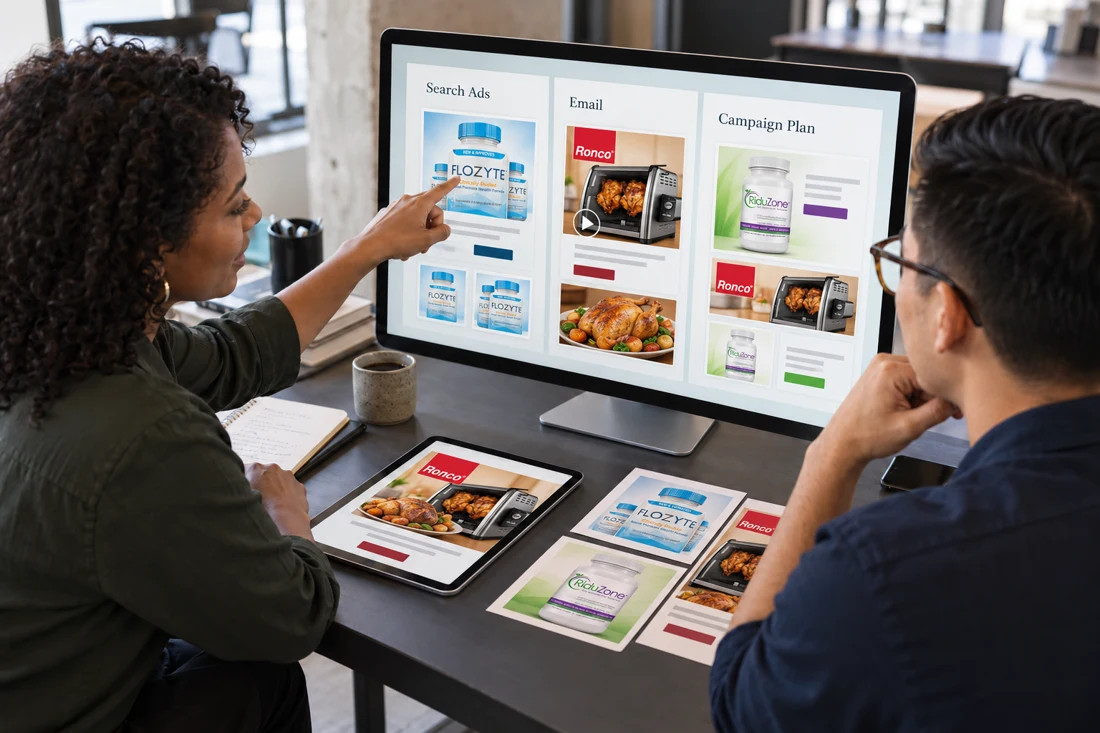
Two people looking at product ads on a screen, with a tablet showing campaign columns and a printed product sheet on the desk

Product and Campaign Experience

Connect the Product Offer, Creative and Landing Page

Revenue Surge brings over 20 years of professional experience to website, creative, and marketing decisions. Our product work connects the name and presentation with the page and the action a buyer can take.

2008

Established in 2008

Revenue Surge was established in 2008. Our product work has included As Seen on TV products, gadgets, kitchen products and supplements.

Start with the offer and the business goal.

Connect the creative with the page and response.

Support claims with product facts, approved examples or records your business can verify.

Discuss Your Campaign

Client Perspectives

What Our Clients Say

Clients and partners describe working with Revenue Surge on websites and marketing.

Dave and his team were able to crush our lead count goals and the quality is awesome. They were able to scale our business quickly...

Greg Paro

The web design provided by Dave was second to none and we've been in the direct response space for over two decades. With Revenue Surge, we ran creative digital marketing campaigns designed to optimize conversion as well as average ticket price...

Jason Galvin

Herbal Groups

Dave provided a solid resource and “home” for my clients that needed direction and counsel on how to maximize their digital efforts from digital media strategies, SEO/SEM and optimal website/landing pages that convert...

John Bosacker

Lee MMS

Direct Response FAQ

Direct Response Marketing FAQs

Find out what the work can include, what affects cost and timing, who approves the offer, and which responses you can verify.

What Is Direct Response Marketing?
Direct response marketing gives a specific audience an offer and asks for a measurable action, such as calling, requesting a quote or placing an order. The ad and landing page should carry the same offer. Check what the business receives to learn whether those actions became genuine inquiries or confirmed orders.
Can You Improve an Existing Campaign or Landing Page?
Yes. We can start with an offer, ad, landing page or response step you already have. We’ll look at what the records can confirm and agree whether a focused change or broader work makes sense. Explore landing page design.
What Determines the Cost of a Direct Response Project?
The starting point and the work involved shape the scope. A focused page improvement differs from developing a product identity, campaign creative, and a new response path. Project work, ongoing support, media spend, and third party costs should be distinguished in the proposal. Pricing and terms are agreed for the project.
What Would Our Team Need to Handle?
Your team provides product or service facts and evidence for claims, and approves the offer, creative and spend. Agree who will handle inquiries or fulfill orders, confirm outcomes and authorize access before the work starts.
How Long Does It Take to Launch and Judge Results?
Launch timing depends on the work, available materials, account access and approvals. Check that the agreed response path works when it goes live. Reviewing inquiry fit, confirmed sales or retained orders takes enough response data and time for sales to close or order adjustments to appear.
Do You Handle Every Marketing Channel?
We choose channels based on who the offer is for, where buyers consider it and what the budget and records can support. The proposal says who handles the creative, media, landing page and measurement for the selected channels. Explore digital marketing services.
Can You Measure Every Sale a Campaign Influences?
Some outcomes can be matched to a campaign when the records share reliable identifiers. Calls, purchases on another device, delayed sales, or missing records can leave the source unknown. Campaign credit depends on reporting rules. Estimating additional sales requires separate evidence, and profit depends on costs.
What Should We Bring to the First Conversation?
One offer, page or campaign concern is enough to start. Share an example if you have one. We’ll discuss what to check first and whether the work belongs in the offer, ad, landing page or response step.

Direct Response Campaigns

Give Buyers a Clear Way to Inquire or Order

Tell us about one offer or campaign concern. We can discuss what the ad asks people to do, what the page shows, and what your business can verify about the response.

A page link or ad example can help if you have one.